
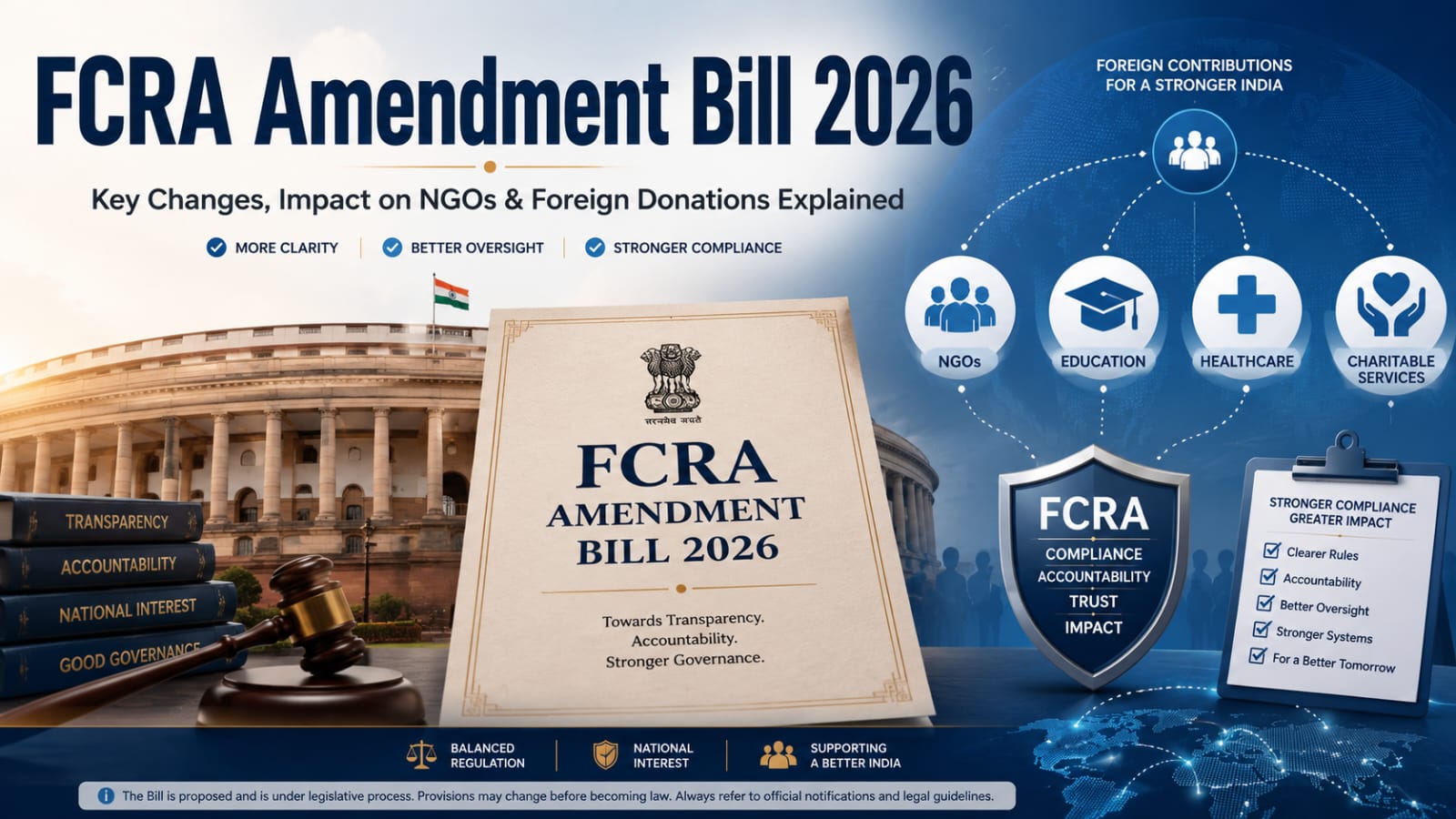
What this FCRA Amendment Bill 2026 guide covers
The Bill focuses primarily on what happens to foreign contribution and assets created from it when an organisation's FCRA certificate ends. It is relevant to NGO trustees, charitable trusts, Section 8 companies, educational bodies, religious organisations, foreign donors and the compliance professionals who advise them.
Quick summary
- A new Designated Authority is proposed to supervise, manage and dispose of specified foreign-contribution assets.
- Expiry, non-renewal or refusal of renewal would be expressly treated as cessation of a certificate.
- Vesting is proposed to be provisional first; permanent vesting would follow if registration is not obtained, renewed or restored within a prescribed period.
- Prior-permission receipts and utilisation would be subject to a prescribed time period.
- The Bill proposes a lower maximum imprisonment term for the general contravention offence, while also defining liability of key functionaries.
What is the Foreign Contribution (Regulation) Act (FCRA)?
The FCRA, 2010 regulates acceptance and utilisation of foreign contribution and foreign hospitality by specified persons and organisations. It requires eligible organisations that want to receive foreign contribution to use the registration or prior-permission route and comply with the Act, rules and conditions.
“Foreign contribution” is defined in the Act and can include donations or transfers of currency, security or specified articles from a foreign source. The exact scope, eligibility, prohibited persons and reporting requirements should be checked in the current statute and rules; this article does not replace them.
Why has the government proposed the FCRA Amendment Bill 2026?
Government statement of objects and reasons: the Bill says operational and legal gaps have arisen around management of foreign contribution and assets when registration is cancelled, surrendered or ceases. It also refers to uncertainty around supervision and disposal of assets, timelines for prior permission, treatment of assets during suspension, penalties, and investigations.
The stated aim is a more comprehensive statutory framework for vesting, supervision, management and disposal through a Designated Authority. This is the government’s stated rationale; it is not a conclusion about the Bill’s eventual effects.
Key provisions of the FCRA Amendment Bill 2026
Express cessation of certificate
Proposed section 14B would deem a certificate to have ceased on expiry where renewal is not applied for, renewal is refused, or the certificate is not renewed before expiry. A person whose certificate has ceased could not receive or utilise foreign contribution unless renewed.
Provisional then permanent vesting
Proposed Chapter IIIA would move specified foreign contribution and assets to a Designated Authority on cancellation, surrender or cessation. The vesting would be provisional initially and may become permanent after the prescribed opportunity to obtain a fresh, renewed or restored certificate.
Assets partly created from other funds
The introduced text says an asset may vest wholly even where created partly with foreign contribution and partly with other sources. It also provides an application route for a distinct or ascertainable portion created or acquired from other sources.
Receipt and utilisation timelines
Prior permission would remain linked to a specific purpose or amount, with the receipt and utilisation required within a period to be prescribed.
Proposed asset-dealing restriction
During suspension, the Bill proposes that assets created from foreign contribution may not be alienated, encumbered or otherwise dealt with without prior Central Government approval.
Penalty and investigation changes
For the general contravention offence, the proposed maximum imprisonment term is one year, compared with the existing section 35 maximum of five years. The Bill also proposes prior Central Government approval before an investigation for an offence punishable under the Act begins.
Existing FCRA framework vs proposed amendment
This comparison is high-level and should be read with the introduced Bill and current consolidated Act.
| Topic | Existing position | Proposed 2026 Bill |
|---|---|---|
| Certificate ending | Cancellation and surrender are addressed; certificate renewal is required under the Act. | New section 14B would expressly deem a certificate to have ceased in specified expiry/non-renewal/refusal situations. |
| Foreign contribution and assets after certificate ends | Section 15 provides for vesting on cancellation or surrender in an authority as prescribed. | Section 15 would be replaced by Chapter IIIA with a Designated Authority and provisional/permanent vesting process. |
| Assets with mixed funding | No equivalent detailed framework in section 15. | Whole asset may vest; a distinct or ascertainable other-source portion may be sought back in the prescribed manner. |
| Prior permission | Permission relates to a specified purpose and amount. | Receipt and utilisation within a prescribed period would be added. |
| Assets during suspension | Use of foreign contribution in custody requires prior approval as provided under section 13. | Dealing with assets created from foreign contribution would also require prior approval. |
| General offence under section 35 | Maximum imprisonment may extend to five years. | Maximum imprisonment would be reduced to one year, or fine, or both. |
Government's stated objectives
The Bill’s statement of objects and reasons identifies a governance and administration focus. In summary, it seeks to:
- clarify cessation of a certificate and the treatment of foreign-contribution assets;
- establish procedures for supervision, management, safeguarding and disposal by a Designated Authority;
- provide timelines for receipt and use under prior permission;
- address handling of assets during suspension;
- rationalise penalties; and
- require prior approval for initiation of an investigation.
The Press Information Bureau has also described the Bill as pending and governance-focused. The Bill’s status must remain central: these are proposed changes, not operative requirements.
Concerns raised by opposition parties, NGOs and legal experts
Public discussion is not uniform. The points below are concerns and analytical questions, not findings of fact by TaxBro.
Asset vesting and renewal risk
PRS Legislative Research notes that a failure to renew may lead to foreign-funded assets vesting in the Designated Authority, and that organisations may be unable to leave the FCRA framework without losing assets created from foreign contribution.
Mixed-source assets
Legal and compliance readers may focus on valuation and identification issues where a property or asset was funded partly from foreign contribution and partly from domestic sources. The Bill refers to a “distinct or ascertainable” other-source portion, while detailed process would be prescribed later.
Process and remedy
PRS also flags that the Act or Bill does not set out an appeal mechanism for a decision denying renewal, and that a hearing before denial is not expressly provided in those provisions. Readers should distinguish this from other statutory or judicial remedies that may be available in a particular case.
Operational continuity
NGOs and institutions may seek clarity on how supervision, banking, employees, programmes, property, ongoing projects and donor commitments would operate while assets are provisionally vested.
Potential impact on organisations and donors
NGOs, charitable trusts and Section 8 companies
The practical focus is likely to be renewal control, asset tracing and readiness to provide records if a certificate is suspended, cancelled, surrendered or ceases. Organisations with land, buildings, equipment or programme assets partly funded through foreign contribution may need especially clear funding-source documentation.
Educational institutions
Institutions receiving foreign contribution should review whether grants support movable or immovable assets, research infrastructure, scholarships or projects with mixed funding. The Bill does not itself create a new live duty while pending, but it points to the records that may matter if enacted.
Religious organisations and places of worship
The introduced Bill specifically states that, where a permanently vested asset is a place of worship, the Designated Authority must ensure that its religious character is maintained. This is a proposed safeguard in the Bill; the prescribed management process is not yet part of current law under this Bill.
Foreign donors
Donors may want stronger grant documentation: purpose, approved recipient, permitted use, asset ownership, reporting, unspent balances and exit/termination provisions. They should not assume a Bill has already changed the recipient’s legal position.
Practical checklist for FCRA-registered organisations
This checklist combines sensible current compliance hygiene with preparation for possible future changes. It is not a substitute for legal advice.
Registration and renewal
- Record the certificate expiry date and internal renewal timeline.
- Assign a board-level owner and a compliance reviewer.
- Keep application evidence, correspondence and portal acknowledgements.
Foreign contribution records
- Reconcile designated bank records, receipts, utilisation and annual reporting.
- Maintain project-wise donor, purpose and utilisation support.
- Check current forms, rules and portal requirements before filing.
Asset register
- Identify assets created wholly or partly from foreign contribution.
- Record invoices, title documents, valuations and funding splits.
- Preserve evidence of any distinct domestic-funded component.
Governance and contingency
- Maintain current details of trustees, directors and key functionaries.
- Document controls for suspension, surrender, cancellation or expiry scenarios.
- Obtain advice before any asset transfer, charge or restructuring.
Major FCRA amendments and developments
| Year | Development |
|---|---|
| 1976 | Earlier FCRA legislation formed the prior regulatory framework. |
| 2010 | Foreign Contribution (Regulation) Act, 2010 enacted; it came into force in 2011. |
| 2011 | Foreign Contribution (Regulation) Rules, 2011 notified. |
| 2016 and 2018 | The Bill’s statement of objects and reasons records amendments in these years. |
| 2020 | Foreign Contribution (Regulation) Amendment Act, 2020 amended several aspects of the framework. |
| 2025 | FCRA Amendment Rules, 2025 were notified; the government described these as procedural in a Lok Sabha reply. |
| 2026 | FCRA Amendment Bill, 2026 introduced in Lok Sabha on 25 March; it remains pending as at 7 August 2026. |
Frequently asked questions about the FCRA Amendment Bill 2026
These question-and-answer headings are ready for search-engine FAQ interpretation and reader reference.
Has the FCRA Amendment Bill 2026 become law?
No. It was introduced in Lok Sabha on 25 March 2026 and is listed as pending. It will not change the law unless it is passed and brought into force through official notification.
Does the Bill stop NGOs from receiving foreign donations?
The Bill does not state a blanket ban on NGO foreign donations. It proposes changes around certificate cessation, asset management, prior-permission timelines, offences and investigations. Existing eligibility and compliance requirements continue to be governed by current law until any new law commences.
What happens if an FCRA certificate expires under the proposed Bill?
Proposed section 14B would treat specified expiry/non-renewal situations as cessation. The Bill proposes provisional vesting of foreign contribution and specified assets in the Designated Authority, subject to the proposed restoration, renewal or fresh-registration process.
Does the proposal affect assets partly bought from domestic funds?
The introduced Bill says the asset may vest wholly, but permits an application for return of a distinct or ascertainable portion created or acquired from other sources. The detailed process would be prescribed if the Bill becomes law.
What does the Bill say about religious places?
For a permanently vested place of worship, the Bill says the Designated Authority must ensure that its religious character is maintained. This is proposed language, not a new operative rule until enacted and commenced.
What should a CA, CS or trustee do now?
Confirm the certificate status, map funding sources for material assets, preserve records, monitor Parliament and official notifications, and seek case-specific advice before making decisions on asset transfers or FCRA status.
Prepare, but do not treat a pending Bill as enacted law
The FCRA Amendment Bill 2026 is important because it proposes a clearer and more detailed asset-management framework for organisations whose FCRA registration ends. Its most material proposed effects concern certificate cessation, provisional and permanent vesting, mixed-funding assets, prior-permission timelines and compliance during transition.
For now, the appropriate response is careful monitoring and record readiness. The Bill may change before it becomes law. Always check the official introduced text, current FCRA law, rules, Gazette notifications and the FCRA portal before relying on any position.
Official and research sources
Introduced Bill text · Lok Sabha Bill status · FCRA, 2010 on India Code · PRS analysis · FCRA portal.